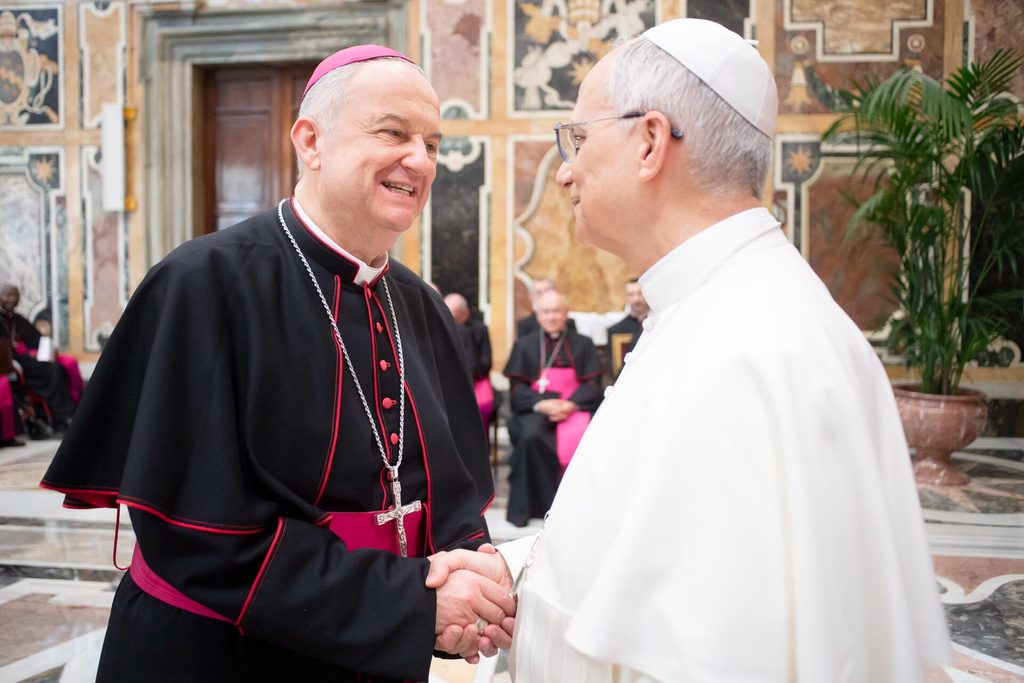
From WelCom’s August edition: Part 1 of an interview with H.E. Archbishop Gábor Pintér, Apostolic Nuncio to New Zealand, the Cook Islands, Fiji, Kiribati, the Marshall Islands, Micronesia, Nauru, Palau, Samoa, Tonga and Vanuatu, and Apostolic Delegate to the Pacific Ocean.
Most Catholics know about the spiritual history of the Holy See. Not as many know about its diplomatic history.
H.E. Archbishop Gábor Pintér, Apostolic Nuncio to New Zealand and several other Pacific nations including Fiji, Samoa, Tonga and Vanuatu, provides a quick lesson. The Holy See, he explains, has the world’s oldest continuously-serving diplomatic corps, dating back to the 5th century – more than 1,500 years ago.
An apostolic nuncio, he says, is the Pope’s permanent diplomatic representative to a sovereign state or international organisation. He attends diplomatic functions with representatives from many countries, meets with government officials and civil society members (such as social organisations), and takes part in community events.
But he also attends Masses and other Catholic events throughout New Zealand and the Pacific, seated by the altar with fellow clergy. Ordained as a priest in 1988 – prior to his diplomatic career – he can deliver homilies, provide blessings, and distribute the precious body and blood of the Eucharist. He’s also the Titular Archbishop of Velebusdus, a community in present-day western Bulgaria, located in Europe between Greece, Turkey, Romania and the Black Sea.
These responsibilities mean he bridges faith and diplomacy. He says if he could describe his role in one word, it would be “coordination.”
Archbishop Gábor explains an example of bridging faith and diplomacy is his work to help ensure the free functioning of the Catholic Church without government interference, so that Catholics can do things like attend Mass without being persecuted. While we have freedom to practise our Catholic faith in New Zealand, this hasn’t always been the case in nations where he’s served as a diplomat.
One example was his time as Apostolic Nuncio to Belarus. The Eastern European nation was formerly part of the Soviet Union. Today it is a close ally of Russia and has supported the ongoing war in Ukraine.
Yet Archbishop Gábor describes a “miracle” of Catholic faith in Belarus surviving the Soviet Union, a decades-long period that lasted much of the 20th century when atheism was enforced and Christians were openly mocked and persecuted by the government. Grandparents, who remembered a time before the Soviet Union, would pass faith on in secret to their grandchildren, at risk of imprisonment in gulags if they were caught. These grandchildren then passed faith on to their own descendants. Today, 35 years after the dissolution of the Soviet Union in 1991, Archbishop Gábor says the Church in Belarus has grown from being at risk of extinction to an estimated two million Catholics – about 20% of the total population.
Archbishop Gábor says a lesson we can learn from this is that everyday people can keep faith alive and nurture it. The nurturing of faith is also something he saw as Apostolic Nuncio to Honduras, his most recent role before being called to New Zealand in 2024, succeeding Novatus Rugambwa.
Archbishop Gábor says it’s a blessing to serve. He adds his roles have shown there’s a real interest in the Church around the world.
Yet his career is also one he did not expect. He says that when he was in seminary in his home country of Hungary, he thought he’d only be a parish priest.
“God has a plan prepared for all of our lives.”