Bishop Philippe Viard SM
Vicar Apostolic 1848-1860; Bishop 1860-1872
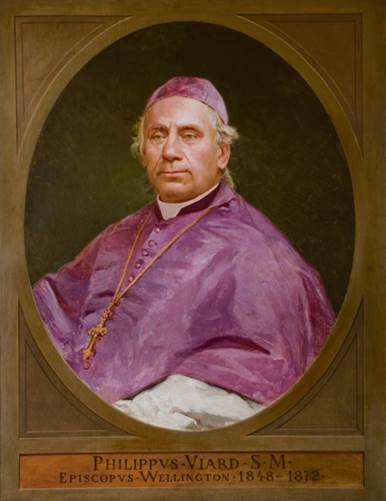
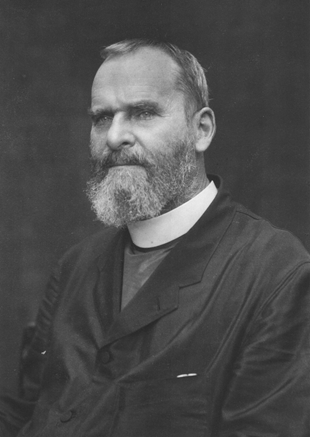
Bishop Viard was appointed as Wellington’s first bishop, initially as Vicar Apostolic while the provisional division of New Zealand into two dioceses was assessed. He arrived on the barque “Clara” on 1 May 1850, with a band of five Marist priests, 10 lay brothers, two male teachers, three Māori and four young women eager to join a religious order and to teach.
On his arrival, Viard bought land in Thorndon on which a bishop’s residence and St Mary’s Convent were built, and the St. Mary’s Cathedral foundation stone was laid. Priests were sent to establish Missions in Lower Hutt, Nelson, Wanganui and Hawke’s Bay. With the arrival of three new Marist priests in 1859, Viard was able to send pastors to New Plymouth, Christchurch, and later to Dunedin. In 1860 he was confirmed as full diocesan bishop.
Bishop Viard struggled with the size of his diocese, and a scarcity of funds and personnel. He attended the First Vatican Council in 1869-70. While he was there the first division of the diocese occurred, with the creation of the Diocese of Dunedin in 1869.
Bishop Viard died on 2 June 1872. The Administration of the diocese fell to the new Bishop of Dunedin, Bishop Patrick Moran, until the appointment of a successor.
Bishop/Archbishop Francis Redwood SM
Bishop 1874-1887; Archbishop 1887-1935
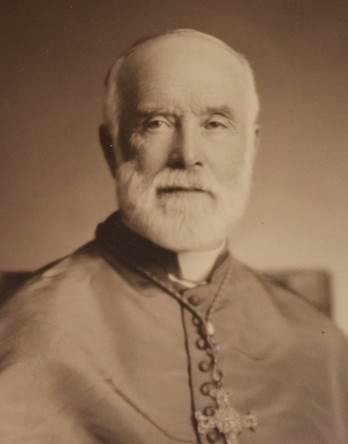
Francis Redwood was bishop for over 60 years, from being the youngest bishop anywhere on his appointment to being the oldest at his death. He closed at least one old church he had opened when it was new.
Redwood was the second of three Wellington bishops from the Society of Mary. He was educated in Nelson and then near Lyon, followed by teaching in Ireland. He met and impressed Bishop Viard, in Europe for the Vatican Council. After Viard’s death, Redwood was appointed bishop despite being only 34 and less than 9 years a priest.
The diocese was raised to an archdiocese on 10 May 1887 from which time Redwood became Metropolitan Archbishop of New Zealand. At the same time, Christchurch became a separate diocese, encompassing Canterbury and Westland.
A man of professorial intellect and demeanour, Redwood was a noted orator. He was a member of the Senate of the University of New Zealand 1877-1903, for which he also acted as examiner in French.
In 1898 Viard’s St Mary’s Cathedral burned down. Redwood saw an opportunity to raise a more imposing cathedral in Te Aro, for which fundraising soon began. This project was never realised, with plans interrupted by war and the Depression, and competing funding priorities such as the new Sacred Heart Basilica and the replacement of St Mary of the Angels. For 86 years Wellington had no Catholic cathedral.
In 1913, when Redwood was 74, he was granted a coadjutor Archbishop: his Vicar General, Thomas O’Shea SM. Redwood set out in 1914 on a round-the-world trip, unfortunately coinciding with the outbreak of World War I.
Archbishop Redwood celebrated 50 years as a bishop in 1924; and 60 years in 1934. He was awarded the French Legion of Honour, and appointed a Count of Rome by the Vatican. He was an active national and international traveller, celebrating his 93rd birthday on a ship to London. Over his lifetime he visited England twenty-one times and was received by five successive Popes in Rome. He died early in 1935 aged 95, after 69 years as a priest and a few weeks short of 61 years as a bishop.
Archbishop Thomas O’Shea SM
Coadjutor Archbishop 1913-1935; Archbishop 1935-1954
Archbishop Thomas O’Shea was 4 when Redwood was ordained bishop, and 64 when he succeeded Redwood as Ordinary.
O’Shea, Rector of St Mary of the Angels and Vicar General, became coadjutor in 1913. A new parish, Wellington East (St Joseph’s), was created for him in Te Aro. This was the intended location for the expected new cathedral.
O’Shea’s administration was based in Mt Victoria and largely independent of Redwood’s in Thorndon. In the mid-1920s the Chancery was created, based under O’Shea in Wellington East. O’Shea took over much of the active work of the Archbishop but had to defer to his senior where their opinions differed, such as the Bible in Schools controversy of the 1930s. O’Shea was in this secondary role for 21 years, before becoming Ordinary in 1935.
Committed to the cause of Catholic Education, O’Shea chaired the Wellington Catholic Education Trust Board from its inception in 1912. A life-long concern for social justice was expressed in his revival of the Society of St Vincent de Paul in Wellington in 1906. He hosted a National Eucharistic Congress in February 1940 as a contribution to the national centennial celebrations.
During the depression of the 1930’s, he encouraged Catholic relief agencies to cooperate with those of other churches, and when the New Zealand Inter-Church Council on Public Affairs was formed in 1941, O’Shea appointed Catholic representatives.
O’Shea’s faculties began to fail in the 1940s, requiring the 1947 appointment of his own coadjutor, Peter McKeefry. McKeefry soon took on the principal work of the Archbishop. O’Shea suffered a stroke in 1950 and spent the remainder of his life in the care of the Little Company of Mary. He died in 1954.
Archbishop/Cardinal Peter McKeefry
Coadjutor Archbishop 1947-1954; Archbishop 1954-1973. Cardinal 1969-1973
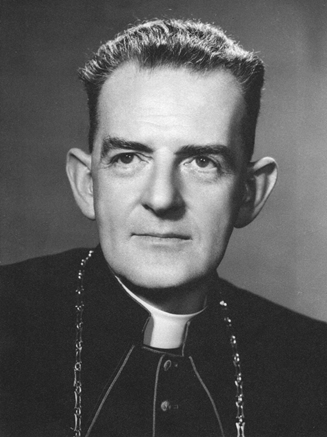
Archbishop Peter McKeefry, born a West Coaster, had been ordained for Auckland under Bishop Liston. When consecrated as coadjutor he was secretary to Liston and editor of Zealandia.
During his tenure, the Catholic population more than doubled from approximately 75,000 to over 150,000 and this resulted the establishment of 39 new parishes. To help meet these needs, numerous religious congregations were sought.
McKeefry was based in the Thorndon presbytery, while the Chancery remained in Wellington East. Sacred Heart was his pro-cathedral. For a time in the mid-1960s it was considered too great an earthquake risk and rough plans for a new diocesan centre were proposed, including a new Sacred Heart further up Guildford Terrace. A large adjacent house was bought to become a residence for the Archbishop, although McKeefry did not move there. This would become the second Viard House.
In the mid-1960s Archbishop McKeefry attended the Second Vatican Council, continuing the work of the first Council attended by Viard almost a century earlier. New advisory bodies were created as a result: the Senate of Priests (1968) and the Pastoral Council (1969).
McKeefry was the first New Zealand-born Archbishop; and in 1969 became the first New Zealander appointed as a Cardinal.
Cardinal McKeefry died in 1973. His auxiliary bishop since 1962, Bishop Owen Snedden, became Vicar Capitular, administering the diocese until a successor was appointed.
Archbishop/Cardinal Reginald Delargey
Archbishop 1974-1979. Cardinal 1976-1979
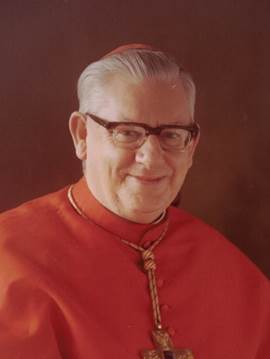
Archbishop Reginald Delargey was appointed from Auckland, where he was an experienced bishop, having been auxiliary from 1958 and Ordinary from 1970.
Archbishop Delargey had attended Vatican II from Auckland and continued with implementing new church practices. Several historical roles disappeared by 1975: Vicars Forane, Censor, Examiners, Assessors, Master of Ceremonies, and the Liturgical Commission.
Another important change was the Private Schools Conditional Integration Act 1975. This permitted the integration of Catholic schools into the state system while retaining their special character, relieving the dioceses of staffing costs. Delargey restructured the diocesan education offices to take this new environment into account. The Catholic Education Centre and the Catholic Education Board were disestablished; new offices for Catholic character, school maintenance and religious education were created.
Archbishop Delargey instituted multiple episcopal vicariates: including Education (1975), Maori and Pacific Islanders (1975, becoming separate vicariates by 1978), Religious and Pastoral Councils (1976, becoming just Religious in 1978) and Overseas Missions (1978). He also created the Archdiocesan Administration Board in 1975 to advise the Archbishop on finance and business matters.
Archbishop Delargey was raised to Cardinal on 24 May 1976, the second New Zealander granted this dignity.
Work began under Delargey to prepare for the creation of Palmerston North Diocese although he did not live to see this. Cardinal Delargey died in January of 1979, leaving Bishop Snedden once again in charge awaiting a replacement.
Archbishop/Cardinal Thomas Williams
Archbishop 1979-2005. Cardinal 1983-2005
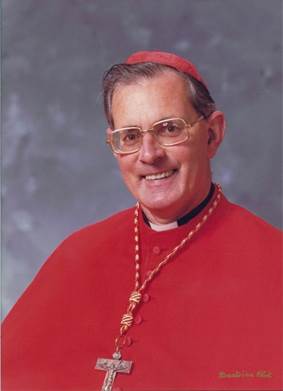
Thomas Williams was appointed Archbishop in late 1979. That year the first integrations of Catholic schools began.
In 1980 the first major boundary alteration since 1887 considerably reduced the territory of the Archdiocese. The regions of Taranaki, Hawke’s Bay and Manawatu became the new Diocese of Palmerston North.
In 1983 Archbishop Williams became the third New Zealand Cardinal.
For 86 years there had been no permanent Catholic cathedral in Wellington; while the pro-cathedral, Sacred Heart, remained under threat as an earthquake risk. In 1984 Cardinal Williams declared Sacred Heart to be the Metropolitan Cathedral, releasing the Cathedral Fund to strengthen and expand the complex.
Following that project, adjacent properties owned by the diocese were demolished to make way for a new diocesan administration building, the Catholic Centre. This Centre, opened in February 1990, permitted co-location of Catholic offices previously scattered across the city, as well as accommodation of national bodies such as the NZCBC, NZCEO and Caritas.
Cardinal Williams held Archdiocesan Synods in 1988 and 1998, and a Samoan Synod in 1999. These Synods set the direction and priorities for the Archdiocese. Cardinal Williams saw these as a mechanism for ‘bottom-up’ management of the Church, in which the Archbishop was one vote of many.
Two innovations from the Synods were the introduction of Pastoral Areas, sharing clergy between close parishes; and Lay Pastoral Leadership, in which lay men and women were trained to augment clergy in the parishes.
Further innovations of Cardinal Williams’ tenure were the establishment of a personal parish for Māori, Te Ngākau Tapu; and a new diocesan newspaper, WelCom. There had not been a diocesan newspaper for 90 years, since Redwood’s Catholic Times had closed.
Cardinal Williams retired in March 2005, remaining Archbishop Emeritus until his death in 2023.